Hydrogen water tablets are small effervescent tablets that, when dropped into a glass of water, dissolve and release molecular hydrogen (H2) gas directly into the liquid. The process looks simple — tablet in, bubbles out — but the underlying chemistry involves a controlled electrochemical reaction designed to maximize the concentration of dissolved H2 before you drink it.
Understanding how these tablets actually work helps set realistic expectations. The chemistry is well-established; the proposed health mechanisms of dissolved H2 are a separate and still-emerging area of research. This article covers both: the reaction that produces hydrogen gas, the physics of how it dissolves into water, and what early research proposes may happen once it enters the body.
Key Takeaways
- Hydrogen tablets generate H2 gas via a magnesium-plus-water (and organic acid) reaction: Mg + 2H₂O → Mg(OH)₂ + H₂↑.
- Dissolved H2 concentrations are physically capped near 1.6 ppm at atmospheric pressure; drink the water promptly after dissolution to preserve concentration.
- The proposed mechanism is selective neutralization of the most cytotoxic reactive oxygen species (hydroxyl radical, peroxynitrite) without broadly disrupting beneficial redox signaling — a hypothesis still under investigation.
- The magnesium byproduct modestly raises solution pH and contributes to dietary magnesium intake; individuals with kidney impairment should consult a physician before regular use.
- The research base for health effects of H2-enriched water is early-stage, primarily from East Asian trials, and does not yet support established clinical claims.
The Core Reaction: Magnesium Meets Water
The active ingredient in most hydrogen tablets is elemental magnesium — typically in the form of magnesium metal powder or magnesium granules. When magnesium contacts water, it undergoes an oxidation reaction: Mg + 2H₂O → Mg(OH)₂ + H₂↑. In plain terms, magnesium gives up electrons to water molecules, splitting them. The hydrogen atoms pair off as H2 gas, which bubbles upward through the water, while magnesium hydroxide (Mg(OH)₂) remains in solution as a mild alkaline byproduct.
This reaction occurs naturally but relatively slowly with plain water. Tablet manufacturers accelerate it by including organic acids — most commonly malic acid or tartaric acid — in the formulation. The acid lowers the local pH around the magnesium particles, increasing reaction rate and producing a more vigorous, sustained release of H2 gas throughout the dissolution window, typically 1 to 3 minutes. The net result is a glass of water that contains elevated concentrations of dissolved molecular hydrogen.
How H2 Dissolves Into Water: Henry's Law and Saturation Limits
Molecular hydrogen is the smallest and lightest molecule in existence, with a molecular weight of just 2 g/mol. This extreme smallness has two important implications: H2 dissolves poorly in water at normal atmospheric pressure, and it escapes back out of solution quickly once the glass is open to air. The relationship between gas pressure and dissolved concentration is governed by Henry’s Law — higher partial pressure of H2 above the liquid drives more gas into solution.
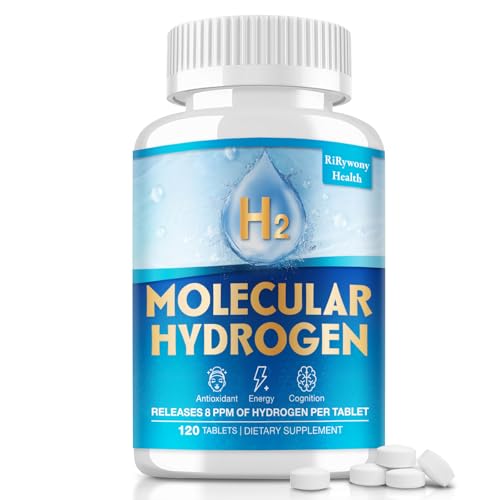
At standard atmospheric pressure, water can hold only about 1.6 mg/L (1.6 ppm) of dissolved H2 at saturation — a ceiling set by physics. High-quality hydrogen tablets are engineered to approach or briefly exceed this saturation point during dissolution by generating H2 faster than it can escape. Practically, this means you should drink the water promptly after the tablet fully dissolves and the bubbling subsides, ideally within 10 minutes, and use a sealed or covered container when possible. Letting hydrogen water sit open in a glass for an extended period allows the dissolved H2 to off-gas and the concentration to drop toward ambient levels.
What the Tablet Leaves Behind: Magnesium Hydroxide and pH
The byproduct of the magnesium-water reaction, Mg(OH)₂, is the same compound found in milk of magnesia. At the concentrations produced by a single tablet dissolved in 200–500 mL of water, it raises solution pH modestly — typically into the 7.5 to 9.0 range depending on formulation, starting water alkalinity, and volume used. This mild alkalinity is generally considered safe for healthy adults and is sometimes marketed as an additional benefit, though claims about alkaline water independently improving health outcomes are not well-supported by clinical evidence.
The magnesium itself is a meaningful consideration. Magnesium is an essential mineral involved in hundreds of enzymatic processes, and many adults consume less than the recommended dietary intake. A standard hydrogen tablet may deliver 40–80 mg of elemental magnesium per serving, contributing to daily intake — though not replacing a balanced diet or addressing frank deficiency. Individuals with kidney impairment should exercise caution with any supplemental magnesium source, as impaired kidneys may struggle to excrete excess magnesium efficiently.
Why Molecular Hydrogen Is Proposed as a Selective Antioxidant
Once dissolved H2 is consumed, it is absorbed rapidly through the gastrointestinal tract into the bloodstream and distributes widely throughout body tissues due to its tiny molecular size. It crosses cell membranes and the blood-brain barrier with relative ease — a property that larger antioxidant molecules cannot match.
The proposed mechanism of action centers on selectivity. Researchers have hypothesized that H2 preferentially neutralizes the most chemically reactive and cytotoxic reactive oxygen species — specifically the hydroxyl radical (•OH) and peroxynitrite (ONOO⁻) — while leaving less reactive species like hydrogen peroxide and superoxide largely intact. This matters because hydrogen peroxide and superoxide serve important signaling roles in cell biology; broad-spectrum antioxidants that scavenge all ROS indiscriminately may interfere with these normal physiological signals. H2’s proposed selectivity, if confirmed, would allow it to reduce oxidative damage without disrupting beneficial redox signaling pathways. This hypothesis is the foundation of the molecular hydrogen research field, though the full picture of how H2 interacts with human physiology remains under active investigation.

Tablet Formats, Concentrations, and What to Look For
Not all hydrogen tablets are equivalent. The amount of H2 actually released into your drinking water depends on the magnesium content, particle size and surface area of the magnesium used, the acid co-formulation, and the volume of water you use. Reputable manufacturers provide H2 concentration data in parts per million (ppm) or milligrams per liter measured in a standardized volume — typically 200–500 mL. A well-formulated tablet should produce concentrations in the 1.0–1.6 ppm range in a covered container.
Tablet stability before use also matters. Elemental magnesium reacts with moisture; tablets exposed to humidity in transit or storage may partially react before you use them, producing lower H2 yields. Better products are individually blister-packed or sealed in foil pouches with desiccants. Some formulations include additional ingredients — zinc, vitamin C, or B vitamins — though these additions are separate from the hydrogen-generating chemistry and should be evaluated on their own merits.

The delivery container matters too. H2 is a small enough molecule to permeate some plastics over time. Glass or stainless steel containers are preferred for maintaining dissolved H2 concentration during and after dissolution. If you use a plastic bottle, drink promptly.
The Research Landscape: What Is and Isn't Established
The chemistry of hydrogen tablet dissolution is straightforward and well-characterized. The proposed biological effects of consuming H2-enriched water are a different matter — an active area of early-stage clinical investigation, with most published trials coming from Japan, South Korea, and China. Study populations are typically small, follow-up periods short (weeks to a few months), and the research has not yet produced the large, long-term, multi-center randomized controlled trials that would establish clinical efficacy for any specific health outcome.
Areas under investigation include metabolic markers, inflammatory parameters, exercise-induced oxidative stress, and neurological conditions. The published human work here is real but early: an eight-week open-label pilot in 20 people with features of metabolic syndrome used water hydrogenated by exactly this magnesium-plus-water reaction and reported a rise in the antioxidant enzyme superoxide dismutase and a fall in urinary oxidative-stress markers, with no change in fasting glucose[1]. What can be said accurately is that molecular hydrogen research is a legitimate and growing scientific field, with a dedicated peer-reviewed journal and hundreds of published studies, but the evidence base remains preliminary and should not be interpreted as proof of disease treatment or prevention. Hydrogen water is not classified as a drug by the FDA, and no disease-treatment claims are permitted or intended.
🛒 Where to Buy Molecular Hydrogen
- Drink HRW Rejuvenation Molecular Hydrogen TabletsLab-tested / studied
tablets, 1 tablet per 500ml water — Research-grade effervescent tablet; developed with involvement from the Molecular Hydrogen Foundation; among the highest documented H2 output per tablet; frequently cited in community as the benchmark - Dr. Mercola Molecular Hydrogen Tablets
tablets, 2 tablets daily in water — Mass-market accessible entry point; wide distribution; uses magnesium as hydrogen carrier; good brand recognition for general wellness shoppers - Water & Wellness H2 Elite Molecular Hydrogen Tablets
tablets, 1 tablet per 16 oz water — Travel-friendly compact packaging; practical for daily carry; good entry-level tablet option for those new to H2 - Susosu Water Hydrogen-Infused Sparkling Water Pouches
liquid, 1 pouch (8 oz) — Ready-to-drink sealed aluminum pouches preserve dissolved H2; Japanese-origin brand; no dissolution required; convenient format for on-the-go use
As an Amazon Associate we earn from qualifying purchases. Molecular hydrogen quality comes down to dissolved H2 concentration, not price. Choose a product that states a specific ppm (mg/L) figure backed by third-party testing, and prefer airtight aluminum or sealed glass packaging — a vague high-concentration claim is unverifiable, and H2 escapes quickly from plastic and open containers.
A Note on the Evidence
The proposed health benefits of molecular hydrogen water are based on early-stage, mostly small-scale research conducted primarily outside the United States, and no health claims have been evaluated or approved by the FDA; hydrogen tablets are not intended to diagnose, treat, cure, or prevent any disease. Individuals with kidney impairment, those taking medications affected by magnesium or pH changes, or anyone with a chronic health condition should consult a qualified healthcare provider before use.
Frequently Asked Questions
What is the chemical reaction inside a hydrogen tablet?
Elemental magnesium reacts with water in the presence of an organic acid (such as malic acid) to produce magnesium hydroxide and molecular hydrogen gas: Mg + 2H₂O → Mg(OH)₂ + H₂↑. The organic acid accelerates the reaction rate, producing a sustained release of H2 gas that dissolves into the surrounding water.
How much hydrogen gas actually ends up in the water?
Dissolution is governed by Henry’s Law; at atmospheric pressure, water saturates at approximately 1.6 mg/L (1.6 ppm) of dissolved H2. A well-formulated tablet dissolved in a covered 200–500 mL container should approach this ceiling, but concentration drops quickly once the water is open to air, so prompt consumption after full dissolution is important.
Is the magnesium in the tablet safe to consume?
Magnesium hydroxide, the reaction byproduct, is the active ingredient in over-the-counter antacids and laxatives and is generally recognized as safe for healthy adults at the concentrations produced by a single tablet. However, people with kidney disease or impaired renal function should consult a healthcare provider before using any supplemental magnesium regularly.
Why does molecular hydrogen need to be selective as an antioxidant?
Many reactive oxygen species serve useful biological signaling functions — hydrogen peroxide, for example, is involved in immune defense and growth-factor pathways. A broad-spectrum antioxidant that eliminates all ROS could theoretically disrupt these signals. Researchers hypothesize that H2 reacts preferentially with the most destructive radicals (hydroxyl radical and peroxynitrite) while leaving lower-reactivity, signaling-relevant species largely intact, though this mechanism continues to be studied.
Does the alkaline pH produced by hydrogen tablets provide separate health benefits?
Claims that alkaline water independently improves health outcomes — separate from the dissolved H2 — are not well-supported by clinical evidence. The mild pH rise from Mg(OH)₂ byproduct is generally considered harmless for healthy individuals, but it should not be conflated with the molecular hydrogen hypothesis, which is a distinct proposed mechanism.
How should I store hydrogen tablets to preserve their potency?
Elemental magnesium is reactive with ambient moisture. Tablets should be stored in individually sealed blister packs or foil pouches with desiccant, kept in a cool, dry location away from humidity and direct sunlight. Opened or improperly stored tablets may partially react before use, yielding lower dissolved H2 concentrations in the final drink.
References
- Nakao A et al. Effectiveness of hydrogen rich water on antioxidant status of subjects with potential metabolic syndrome-an open label pilot study. J Clin Biochem Nutr (2010). PMID 20216947
These statements have not been evaluated by the Food and Drug Administration. This information is not intended to diagnose, treat, cure, or prevent any disease. Content is for informational purposes only and is not medical advice; consult a qualified healthcare provider before starting any supplement. As an Amazon Associate we earn from qualifying purchases.
